


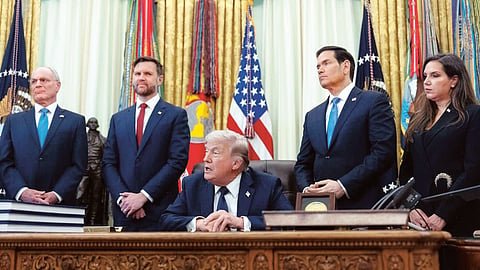
US President Donald Trump announced on April 25, 2026 that the Israel-Lebanon ceasefire has been extended by three more weeks. The announcement came following a second round of peace talks held in Washington between the parties involved, signalling a continued but fragile effort to prevent a full-blown war from breaking out in the region.
The ceasefire, which was originally brokered by the United States, had been due to expire imminently. Trump stated that both sides had agreed to the extension, adding that there was “no time frame” for a permanent resolution and “no time pressure” on the talks.
What Is Happening in the Region
Meanwhile, the broader regional conflict continues. Iran and the United States remain locked in a diplomatic standoff over Tehran’s nuclear programme and ongoing maritime tensions in the Strait of Hormuz. Iran’s Islamic Revolution Guard Corps reported the seizure of two vessels in the Strait, raising fresh concerns over the security of one of the world’s most critical energy corridors. The US has maintained its military posture in the region and vowed to continue enforcing restrictions.

The situation in Lebanon remains tense. Israeli attacks in recent days had killed several civilians, including a Lebanese journalist, deepening concerns about the humanitarian situation. The ceasefire extension offers a breathing space, but analysts caution that the underlying issues, including Hezbollah’s military presence in southern Lebanon and Iran’s regional ambitions, remain unresolved.
Why India Is Watching Closely
For India, the developments in the Middle East carry significant economic importance. India is a major importer of crude oil from the Gulf region, and any escalation in the Strait of Hormuz directly impacts oil prices and by extension fuel costs at home. Global energy prices have already risen by nearly 15 percent amid the regional instability, according to various reports.
India has maintained a position of diplomatic balance on the Middle East conflict while prioritising its own energy security and the welfare of the large Indian diaspora working in Gulf countries.
The ceasefire extension, while not a permanent solution, is seen as a positive step by most international observers. The next few weeks will be crucial in determining whether talks can progress to a more lasting arrangement.
